
International Student Workers
International student workers have the same legal right to join unions as US citizens
Under state law, international grad student employees have the same rights to join and participate in unions as US citizens. This includes anyone on a F1, J1, or H1B visa. In fact, tens of thousands of international students are part of unions already, including at institutions like the University of California system, University of Southern California, MIT, Harvard, Columbia University, and the University of Washington.
In 2017, the Pennsylvania Labor Relations Board (PLRB) ruled that Penn State graduate assistants have the right to unionize under the Pennsylvania Employee Relations Act (PERA). This right applies to all employees, regardless of immigration or visa status. State law explicitly prohibits employers from retaliating against any worker, regardless of visa or immigration status, for participating in union activity. Under PERA, all international graduate student employees have the same protected rights as US citizens to participate in union activities, sign union authorization cards, vote in a union election, join a union, etc.
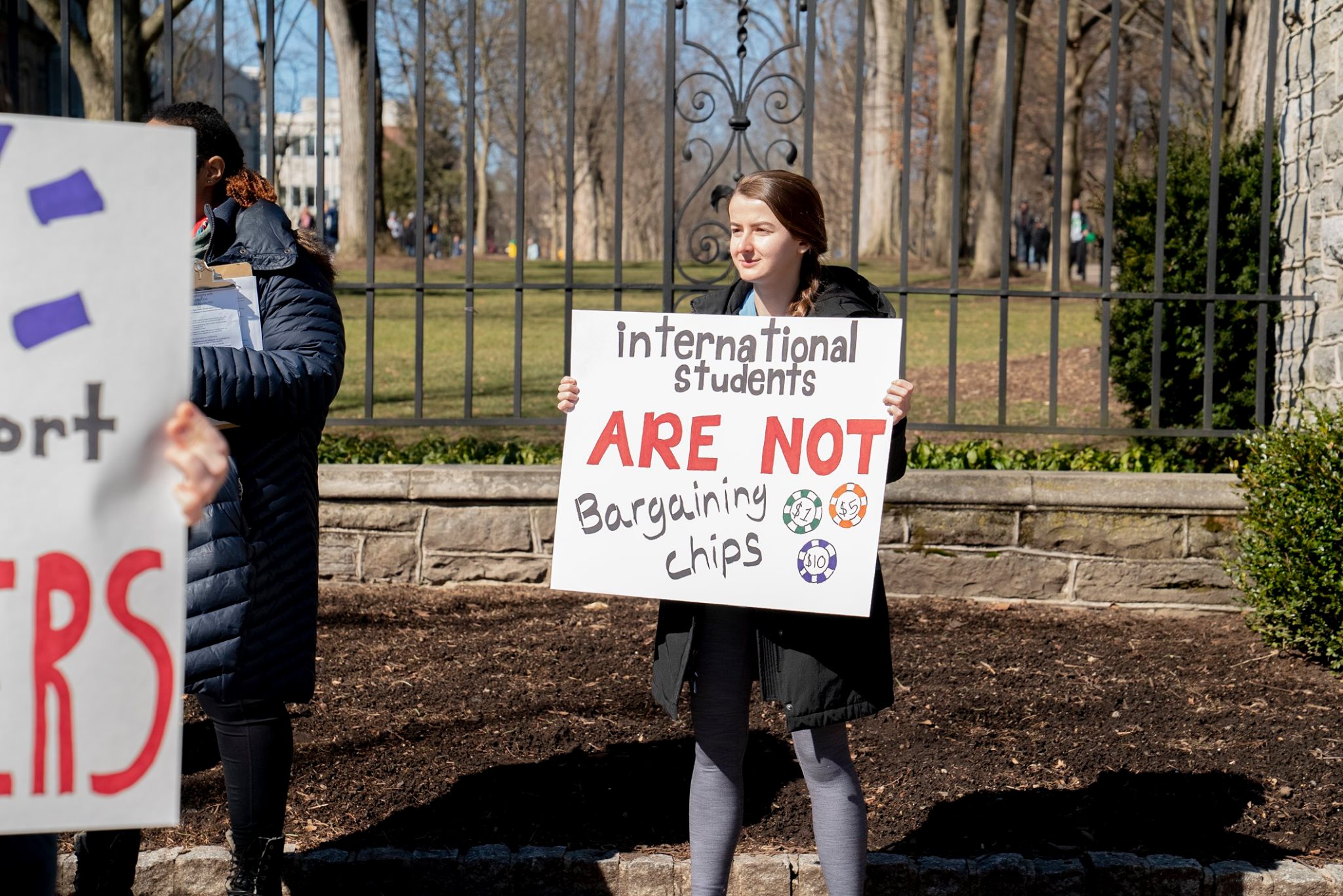
Unions are especially important for international workers
As international grad student workers, we face unique challenges and greater precarity due to our status as visa holders. This can come from multiple sources—changing Federal immigration policies that affect scholars and their dependents, challenges with housing and healthcare, and bureaucratic university processes. On top of this, recent surveys conducted by Nature have found that due to the instability of their visa status, international researchers feel more vulnerable and are more likely to face certain types of abuse.
Unions help address all of these issues by building a supportive community in which all grad workers can thrive and empowering us to negotiate an enforceable contract with Penn State management. Our contract can include provisions like protections from abusive conduct, protection from unfair termination, low-cost healthcare, guaranteed vacation, and provisions that help avoid work-authorization delays (see for example UC grad researchers). Unions provide international grad workers with greater security, a platform for advocacy, and a stronger community.
How do other union contracts improve job security and protect grad workers from abuse?
Academic unions have been able to win provisions in union contracts that define discrimination, harassment, and abusive conduct. They can also have provisions that prevent unfair termination, guarantee multi-year postdoc appointments, and protect against overwork. Crucially, these protections are enforceable through a grievance process. A strong union grievance process, like the one grad workers won for the UC system, includes:
-
- Representation throughout the process, so that if you file a grievance you are supported and not going through it alone
- Timelines to ensure issues are dealt with in a timely manner
- Interim measures that must be taken in cases of harassment, discrimination, or abuse so that the grad worker can continue to work in a safe environment while an investigation takes place
- The ability to appeal to a neutral third party
How do academic unions help with visa and immigration issues?
Other academic unions have worked together to improve US immigration policy, provide information and advice, and help individual researchers facing visa and immigration hurdles. Unions have also won contractual benefits for international grad workers, like:
- MIT grad workers won a $1,200 reimbursement for visa-related costs. Their contract also includes new protections for international grad workers, like timelines within which the International Student’s Office must respond to inquiries.
- Harvard grad workers won a $100,000 annual fund to reimburse some of the costs associated with immigration and maintenance of legal working status within the United States.
- University of California grad workers recent contracts guarantee days off for visa-related appointments and guaranteed remission of the Non-Resident Student Tuition fee for PhD candidates.
Academic unions work together for more just and fair US immigration policy
Research and teaching is an international endeavor and the entire academic community benefits from just and fair visa and immigration policies that treat workers with dignity and respect irrespective of their place of origin. For example, UAW academic workers across the US have worked together to:
- Stop the “fixed duration of status” rule from going into effect
- Expand and extend Optional Practical Training (OPT)
- Oppose the 1-year period of validity for Chinese entry visas
- Organize information sessions in response to changing immigration policy
- Extend the initial postdoc employment contract at Caltech to a 2-year period to reduce visa costs and provide immigration stability for scholars and their dependents
What about strikes?
Striking is a tactic some groups of academic employees have chosen to use in response to unfair labor practices or employers refusing to engage at the bargaining table. In UAW, a strike must be authorized by a 2/3rds vote, and no individual can be compelled to participate in a strike.
Many protections exist to ensure the rights of international grad workers to participate in union actions, including strikes, and there have been no reported instances of international scholars facing negative consequences to their visa status as a result of going on strike. Any action taken by Penn State management against international grad workers for participating in union activity, including a strike, would be considered retaliation and is illegal under the Pennsylvania Employee Relations Act. Retaliation would also likely provoke outrage from the broader academic community in the US and abroad, further disincentivizing Penn State from taking an illegal action.
Successful strikes are generally planned months in advance and discussed in campus town halls, in department meetings, and amongst members of the same lab groups. They can be a powerful way to put pressure on an employer to cease stalling at the bargaining table and agree to a fair contract (for example recent contracts at the University of California and the University of Washington). That said, many academic union contracts are negotiated without resorting to a strike (for example at MIT). By forming a union, we gain the right to negotiate with Penn State management over our working conditions. With a union, we will evaluate and choose for ourselves the tactics that are right for us to reach a fair agreement.